Vahid Jahangiri

Assistant Professor
Department of Mechanical, Industrial & Systems Engineering
University of Rhode Island (URI)

Research

Structural vibration control is crucial for ensuring the safety and reliability of infrastructures. Excessive vibrations can lead to structural fatigue which can reduce the reliability of structures. In seismic regions, vibration control is essential for mitigating earthquake-induced forces, preventing catastrophic failures. Additionally, it improves the performance of bridges and towers, maintaining their stability under dynamic loads. Different active, passive, semi-active, and hybrid controlling strategies have been proposed to effectively reduce the vibrations of the structures. Tuned mass dampers are one of the most well-known strategies to reduce the vibrations of structures.

The following video demonstrates how a pendulum-type tuned mass damper moves during a 6.8 earthquake event:

https://www.youtube.com/watch?v=5NNKWOOMTJs

Vibration reduction of Offshore Wind Turbines:

Offshore wind turbines are subjected to harsh environmental loadings such as waves, winds, currents, etc. The excessive loadings applied to offshore wind turbines negatively impact their fatigue life and reliability. Therefore, it is crucial to equip these structures with effective controlling devices.

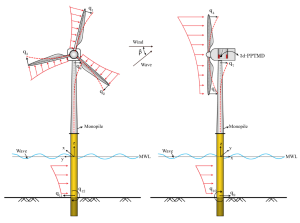
  • Vibration Control of Fixed-Bottom Offshore Wind Turbines using Pendulum Tuned Mass Damper: This project aimed to reduce the vibrations of wind turbine tower in two directions of fore-aft and side-side directions. Therefore, a pendulum-tuned mass damper was proposed. The simulation results proved that the pendulum tuned mass damper outperforms the traditional tuned mass dampers in reducing the vibrations of the wind turbine tower in two different directions. Moreover, the fatigue damage for the wind turbine tower was calculated and it was found that the fatigue damage of the tower was reduced significantly when a pendulum tuned mass damper was used. 
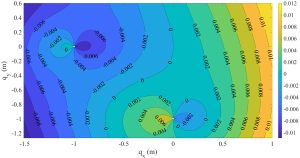
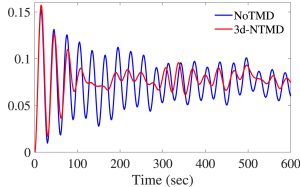
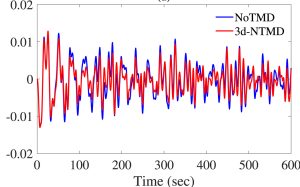
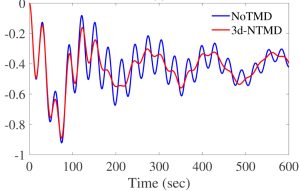
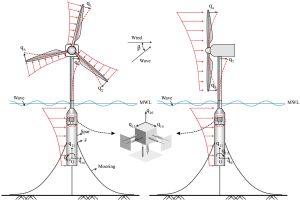
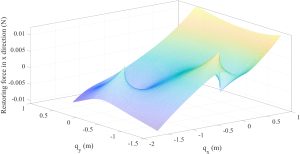
  • Motion Mitigation of Floating Wind Turbines: The main goal of this project was to control and mitigate the motion of floating wind turbines in three different directions. For this purpose, a three-dimensional nonlinear tuned mass damper (3d-NTMD) was proposed to mitigate the motion of the floating wind turbine in three directions of pitch, roll, and heave at the same time. The nonlinear behavior of the proposed 3d-NTMD was studied and after optimizing its parameters, it was found that the 3d-NTMD can reduce the motion of the floating wind turbine in all three directions of pitch, roll, and heave.
                                  

Real-Time Hybrid Simulation of Offshore Wind Turbines

Offshore wind turbines are exposed to various environmental loadings such as waves, winds, currents, etc., and experience complex dynamic responses during their operational life. These different forms of loads, along with soil-structure interactions make it challenging to predict the dynamic behavior of the system. Numerous numerical models for offshore wind turbines have been developed in recent years to accurately predict the responses of offshore wind turbines; however, numerical models and tools adopt approximate theories, which lose accuracy when complex nonlinear effects (load effects or structural responses) in the system become significant. Therefore, physical model testing of OWTs in wind tunnels or wave tanks is critically important to accurately predict the responses of the system. Physical model testing of OWTs involves aerodynamics and hydrodynamics, where the Reynolds and Froude scaling laws are the two primary scaling laws used in the testing.
Unfortunately, Reynolds scaling and Froude scaling cannot be satisfied simultaneously because of the scaling conflicts. 
Model testing in wave tanks often adopts the Froude scaling law, where the Froude number is maintained as constant in the reduced model and full-scale prototype via appropriate scaling design. While the Froude scaling ensures the similitude of hydrodynamic forces, it cannot maintain the same viscous effect due to the reduced Reynolds number. As a result, the aerodynamic load effects (e.g., aerodynamic torque and blade inertia force) on blades cannot be accurately modeled. Real-time hybrid simulation has been used to overcome the Reynolds and Froude scaling incompatibility in model
testing.
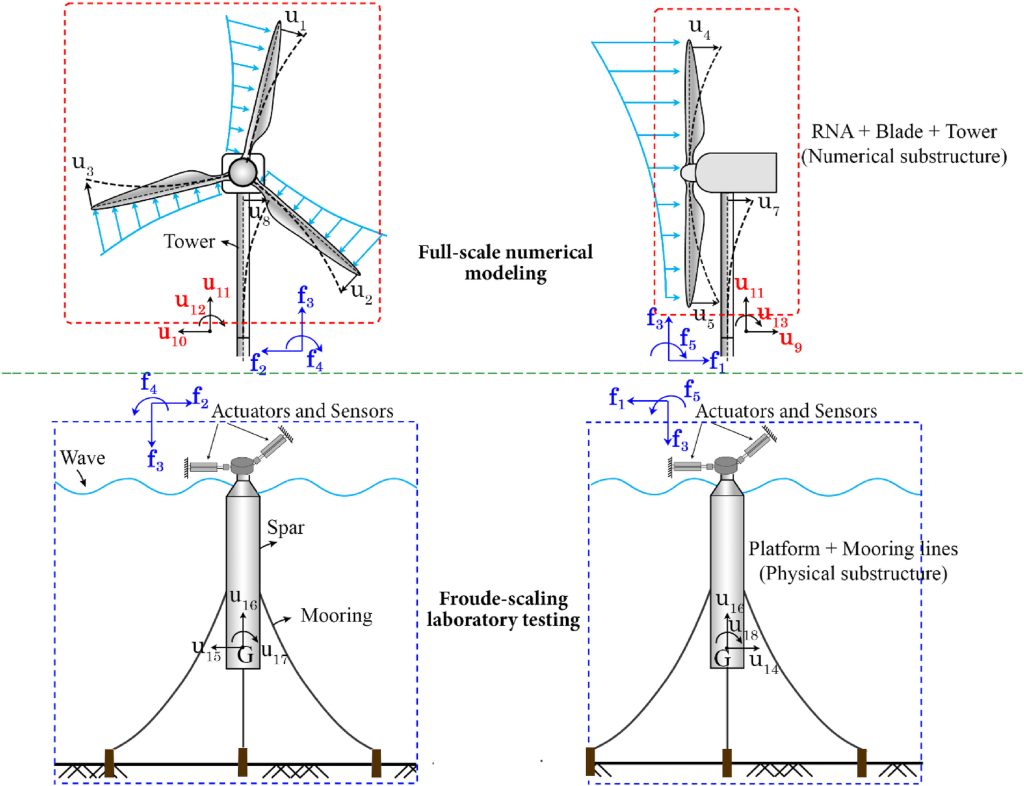
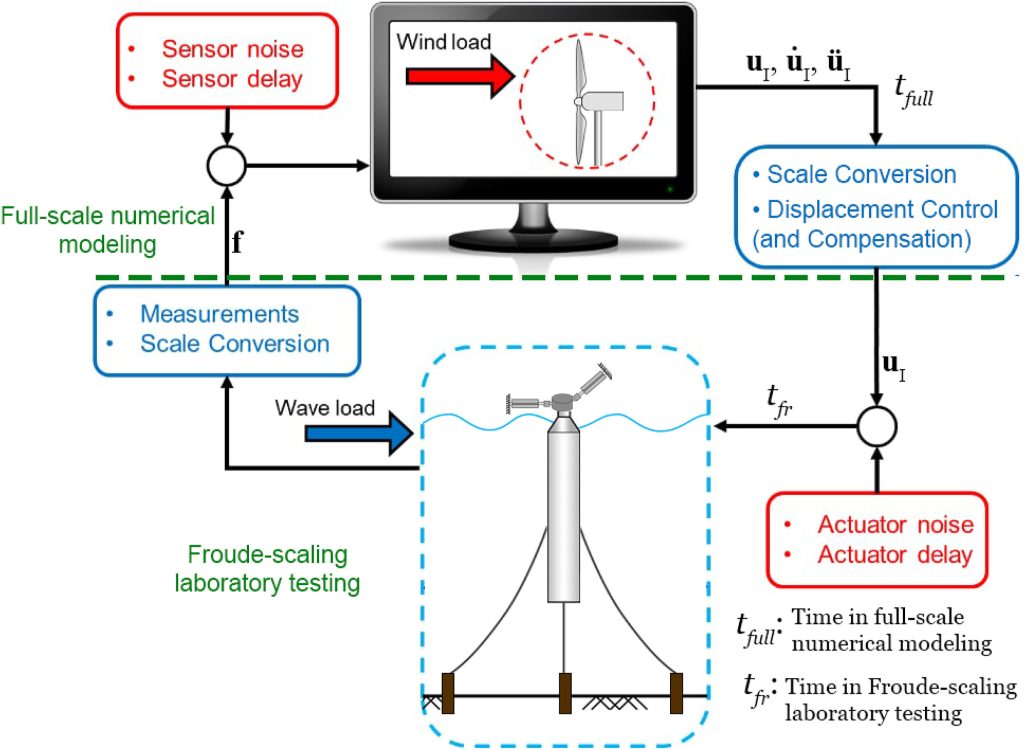
 In real-time hybrid simulation, the original system is divided into a numerical and a physical subsystem, where the numerical subsystem is simulated using numerical models with good accuracy and confidence, and the physical subsystem is tested under realistic conditions. The two subsystems communicate via actuators and sensors to provide the desired dynamic responses of the physical subsystem and an in-depth understanding of the entire complex system. The present project focuses on developing a general real-time hybrid simulation framework for offshore wind turbines and evaluates the performance via systematically examining the delay and noise-induced errors between scaled real-time hybrid simulation and the full-scale prototype, and reveals their impact on the offshore wind turbine structural responses.
 

Engineering structures and mechanical systems frequently encounter adverse conditions that lead to damage and failures over their service lives. Over time, materials deteriorate, reducing the structure’s load-carrying capacity. Therefore, it is crucial to identify such damages, typically done through structural health monitoring and condition monitoring methods.  By identifying issues promptly, necessary repairs can be made before minor problems escalate into major, costly repairs or replacements. Additionally, effective damage identification enhances the resilience of infrastructure, ensuring it can continue to function effectively. This process is important for protecting public safety, maintaining economic stability, and supporting the sustainable development of our built environment.
 
Structural Damage Identification of Offshore Wind Turbines:
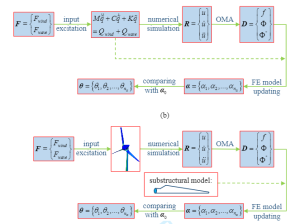
A two-step strategy was proposed for damage identification of offshore wind turbines using a Finite Element Model Updating. Using this methodology, the damaged component of the offshore wind turbine was identified using a verified global numerical model. With the identified damaged components identified in the first step, the exact location and quantification of the damage were determined in the second step. The obtained results of this project show that the proposed methodology was able to identify the structural damage on offshore wind turbines.
 
Digital Twin of Wind Turbine Drivetrain Systems:
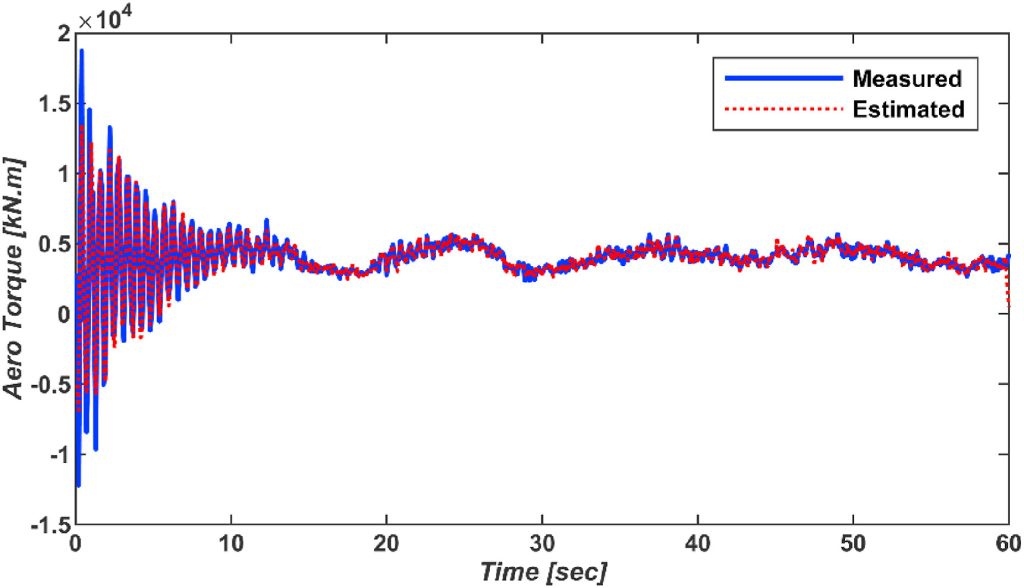
 Wind turbine drivetrain systems including the main shaft, main bearing, and gearbox components experience a large number of failures in their operational life causing a significant amount of downtime and energy loss in wind turbines. The current project implements a Bayesian inference method to estimate uncertain parameters of a physics-based wind turbine drivetrain model. Also, the current methodology is used to estimate unknown input loads to the drivetrain. The implemented Bayesian inference method was able to successfully estimate the uncertain parameters along with the aerodynamic torque jointly. This technique can be used to monitor variations in the drivetrain system parameters for damage diagnosis and predictive maintenance purposes.

Publications

Journal Papers

  1.  M. Valikhani, V. Jahangiri, H. Ebrahimian, B. Moaveni, S. Liberatore, E. Hines “Inverse Modeling of Wind Turbine Drivetrain from Numerical Data Using Bayesian Inference”, Renewable & Sustainable Energy Reviews, 171 (2023), 113007. 
  2.  C. Sun, W. Song, V. Jahangiri,“A Real-Time Hybrid Simulation Framework for Floating Offshore Wind Turbines”,Ocean Engineering, 265 (2022), 112529. 
  3. V. Jahangiri, C. Sun, “A Novel Three Dimensional Nonlinear Tuned Mass Damper and Its Application in Floating Offshore Wind Turbines”, Ocean Engineering, 250 (2022), 110703. 
  4. Z. Zhang, C. Sun, V. Jahangiri, “Structural Damage Identification of Offshore Wind Turbines: a Two-Step Strategy via FE Model Updating”, Structural Control & Health Monitoring, (2021), e2872.
  5. V. Jahangiri, C. Sun, F. Kong, “Study on a 3D Pounding Pendulum Tuned Mass Damper for Mitigating Bi-Directional Vibration of Offshore Wind Turbines”, Engineering Structures, 241 (2021) 112383. 
  6. C. Sun, V. Jahangiri, H. Sun, “Adaptive Bi-Directional Dynamic Response Control of Offshore Wind Turbines with Time-Varying Structural Properties”, Structural Control & Health Monitoring, (2021) e2817.
  7. M. Rezaee, R. Fathi, V. Jahangiri, M. M. Ettefagh, A. Jamalkia, M. H. Sadeghi, “Detection of Damages in Mooring Lines of Spar Type Floating Offshore Wind Turbines Using Fuzzy Classification and Arma Parametric Modeling”, International Journal of Structural Stability and Dynamics, (2021) 2150111.
  8. B. Zhu, C. Sun, V. Jahangiri, “Characterizing and Mitigating Ice-Induced Vibration of Monopile Offshore Wind Turbines”, Ocean Engineering, 219 (2020) 108406. 
  9. V. Jahangiri, C. Sun, “Three-dimensional Vibration Control of Offshore Floating Wind Turbines Using Multiple Tuned Mass Dampers”, Ocean Engineering. 206 (2020) 107196. 
  10. W. Song, C. Sun, Y. Zuo, V. Jahangiri, Y. Lu, Q. Han, “Conceptual Study of a Real-Time Hybrid Simulation Framework for Monopile Offshore Wind Turbines under Wind and Wave Loads”, Frontiers in Built Environment, section Computational Methods in Structural Engineering. 6 (2020) 129. 
  11. C. Sun, V. Jahangiri, H. Sun, “Performance of a 3D Pendulum Tuned Mass Damper in Offshore Wind Turbines under Multiple Hazards and System Variations”, Smart Structures and Systems. 24(1) (2019) 53-65. 
  12. V. Jahangiri, C. Sun, “Integrated Bi-Directional Vibration Control and Energy Harvesting of Monopile Offshore Wind Turbines”, Ocean Engineering. 178 (2019) 260-269.
  13. C. Sun, V. Jahangiri, “Fatigue Damage Mitigation of Offshore Wind Turbines Under Real Wind and Wave Conditions”, Engineering Structures. 178 (2019) 472-483. 
  14. V. Jahangiri, M. M. Ettefagh, “Multibody Dynamics of a Floating Wind Turbine Considering the Flexibility Between Nacelle and Tower”, International Journal of Structural Stability and Dynamics. 18 (2018) 1850085. 
  15. C. Sun, V. Jahangiri, “Bi-Directional Vibration Control of Offshore Wind Turbines using a 3D Pendulum Tuned Mass Damper”, Mechanical Systems and Signal Processing. 105 (2018) 338-360. 
  16. V. Jahangiri, H. Mirab, R. Fathi, M. M. Ettefagh, “TLP Structural Health Monitoring Based on Vibration Signal of Energy Harvesting System”, Latin American Journal of Solids and Structures. 13 (2016) 897-915.
  17. H. Mirab, R. Fathi, V. Jahangiri, M. M. Ettefagh, “Energy Harvesting from Sea Waves with Consideration of Airy and JONSWAP Theory and Optimization of Energy Harvester Parameters”, Journal of Marine Science and Application. 14 (2015) 440-449.

Conference Papers

  1. M. Valikhani, V. Jahangiri, H. Ebrahimian, B. Moaveni, S. Liberatore, E. Hines “Aerodynamic Load Torque Estimation in Wind Turbine Drivetrains Using Bayesian Data Assimilation Approach”, IMAC-XLI, Austin, TX, 2023.
  2. V. Jahangiri, M. Valikhani, H. Ebrahimian, B. Moaveni, S. Liberatore, E. Hines “Digital Twinning of Wind Turbine Drivetrain”, IMAC-XL, 2022, Virtual.
  3. V. Jahangiri, C. Sun, “Vibration Reduction of Wind Turbine Blade Using a Multi Directional Tuned Mass Damper Inerter”, 8th World Conference on Structural Control and Monitoring, 2022, Orlando, FL, USA.
  4. V. Jahangiri, C. Sun, “A Novel 3D Nonlinear TMD and it’s Application in Reducing Vibrations of FOWTs”, Engineering Mechanics Institute (EMI), 2021, Virtual.
  5. B. Zhu, C. Sun, V. Jahangiri, H. Yan, “Mitigation of Jacket Offshore Wind Turbines Under Misaligned Wind and Ice Loading Using a 3D Pendulum Tuned Mass Damper”, The 30th International Ocean and Polar Engineering Conference, 2020, Virtual.
  6. V. Jahangiri, C. Sun, “Bi-directional Vibration Control of a Monopile Offshore Wind Turbine Using a 3D Pounding Pendulum Tuned Mass Damper”, Engineering Mechanics Institute (EMI), June 2019, Pasadena, CA, USA.
  7. C. Sun, V. Jahangiri, H. Sun, “Bi-directional Response Mitigation of Offshore Wind Turbines Under Multiple Hazards”, 7th World Conference on Structural Control and Health Monitoring, 2018, Qingdao, China.
  8. C. Sun, V. Jahangiri, “Integrated Vibration Control and Energy Harvesting of Offshore Wind Turbines Subjected to Misaligned Wind and Wave Loading”, Structures Congress, 2018, Fort Worth, TX, USA.
  9. C. Sun, V. Jahangiri, “Mitigation of Monopile Offshore Wind Turbines Under Wind and Wave Loading”, Americas Conference on Wind Engineering, 2017, Gainsville, FL, USA.